For our first task in History & Context, we have been asked to create an A2 Typographic Collage using only type and text-based material.
To begin with, we looked at the Tate Modern Artist Timeline. In my own time, I looked through the different time periods and chose to look at Robert Capa, Odilon Redon and Donald Judd. I tried to look at artists in different time periods and movements, to have a variety of different works to look at and analyse.
Robert Capa
Robert Capa was a Photojournalist, who appeared on the Tate timeline in 1930. He has been remembered as one of the greatest war photographers of the 20th Century, documenting armed conflict and it’s effects on people and places. In 1954, he was killed while photographing in combat, at the age of 40. I have chosen to look at Capa as my boyfriend is currently serving in the forces. I personally find Capas’ work inspiring as photography like this involves putting yourself in harms way. I will be focusing on a particular photograph of a solider and his love saying goodbye before deployment (shown below), as this is a moment I can personally relate to.

I absolutely adore this photograph due to how raw it is. I find it a very emotional image, as it breaks the stereotypes and expectations of standard military photography. The couple are focusing on the good times rather than the sad fact that they may never see each other again.
Odilon Redon
Odilon Redon’s work is made by etching and printmaking, who appeared on the Tate Timeline in 1900 in the symbolism movement. His work consists of neural colour tones and quirky and strange figures.
The neutral colour pallet and the use of printmaking is very similar to my personal style. His work is very quirky, particularly his piece named “The Eye Like a Strange Balloon Mounts Toward Infinity,” which I will be focusing my attention on during the writing of the 50 words.
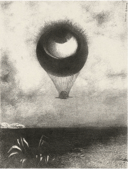
I find this an interpretation of the saying “eye in the sky”. The print depicts a large eye in the shape of what appears to be a hot air balloon. To me, this is symbolic of the idea that we are always under surveillance and being watched in modern society.
Donald Judd
Donald Judd is a minimalist artist who appeared on the timeline in 1960. His work is mostly sculpture, arranging bold coloured blocks.
I dislike his work very much as I find it extremely uninteresting and pointless. I do not think that there is any artistry, imagination or talent in stacking coloured blocks on top of each other and I can’t identify any meaning or symbolism.

Choosing my favourite artist to develop and create collage:
I have chosen to develop the fifty words of the military photojournalism works of Robert Capa. As described within the sentence, I feel that his work is more personal to me and something I feel quite strongly about and can create a powerful short text about his work.
Second re-write and shortening (aiming for no more than 30 words):
Emotive war photography breaking the usual approach of normal military photography by focusing on the happiness rather than pain and loss.
Final re-write
“War photography breaking the usual approach of military photojournalism by focusing on happiness rather than only sadness, loss and pain.”
Plan for collage:

From a rough mind map of ideas, I decided to keep the majority of the collage black and white to replicate Capa’s photography. I also picked out the most powerful words in my sentence and decided these words will be larger than the others, to highlight the main ideas and concepts. I briefly thought about creating images with the words, but thought that would make it a little too difficult to read.
Rather than sketch out ideas of word placement, I cut out all my letters and played around with the words and their placement.
End product:

Rationale:
My artwork was about being able to use only type and text-based material to create a typographic collage in the style of Robert Capa. I chose to look at Capa as his work has personal meaning to me with my boyfriend currently serving in the forces. I kept the majority of the collage in black and white to link back to Capa’s black and white photographs, but added a few red letters to inject a bit of depth and lift the college. I picked out what I felt were the most important words in my sentence and made them larger than the other words, to enforce the ideas, concepts and effects of Capa’s photography.
 Nadya Cheetham