Brief:
- Select a topic you are interested in. Find a signal.
- “What if…” Create a speculative response (product or service).
Outcome: 1 minute video including the following:
- Present the problem based off your signal
- Present the Product or service (Introducing..) Brand it.
- How it works
- Final Slogan
Research & Speculative Design:
Think cultural, economic changes.
Speculate the ecosystems:
- What does the future environment look like?
- What are the challenges and/or rules?
- What are the states of technology?
Determine Social and Cultural changes:
- What impact will design have on society?
- How does it change our behaviour socially and/or psychologically?
- What are the good and bad knock on effects?
Focus on the possibilities of the future. How can emerging technology help current/future problems? What issues can my product solve and what further issues or concerns would it bring?
KEEP IT SIMPLE!
What if…
Imagine and envision possible future scenarios. Mix disciplines to speculate a design outcome and challenge social constructs.
Inspiration:
Black Mirror – ArkAngel Season 4, Episode 2
Arkangel shows the lengths a parent will/would go to to keep their child safe, away from harm, and under control. After loosing her three-year-old daughter at a park, a mother makes the decision to get Arkangel chip implanted in her daughter. This chip allows the mother to monitor her daughters whereabouts, health and emotional state and wellbeing through a digital tablet, similar to an iPad. The System also allows real life parental controls, blocking the Childs vision of whatever her mother sees fit.
Black Mirror, The Entire History of You, Season1, episode 3.
An implant that allows humans to record and replay their lives. Main character, becomes obsessed and begins to believe his wife is cheating on him. In a fit of jealously , he forces her to replay her memories with other men in front of him. Eventually cuts off his ear in an attempt to remove the chip. Take-away thought- Sometimes, ignorance is bliss!
Brainstorm – Notes:
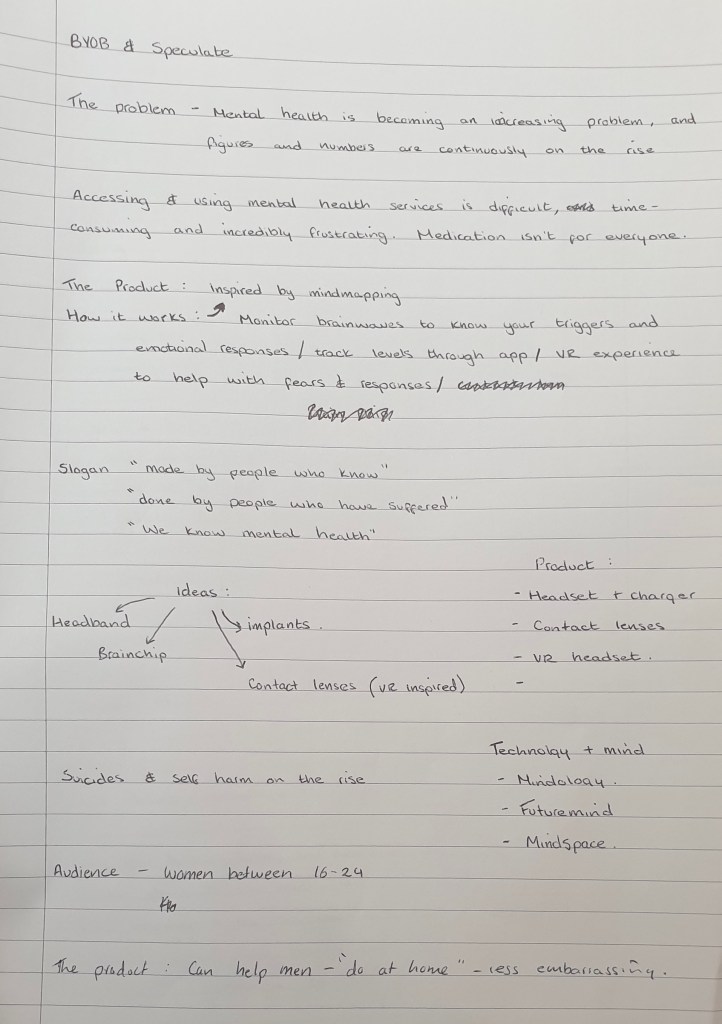
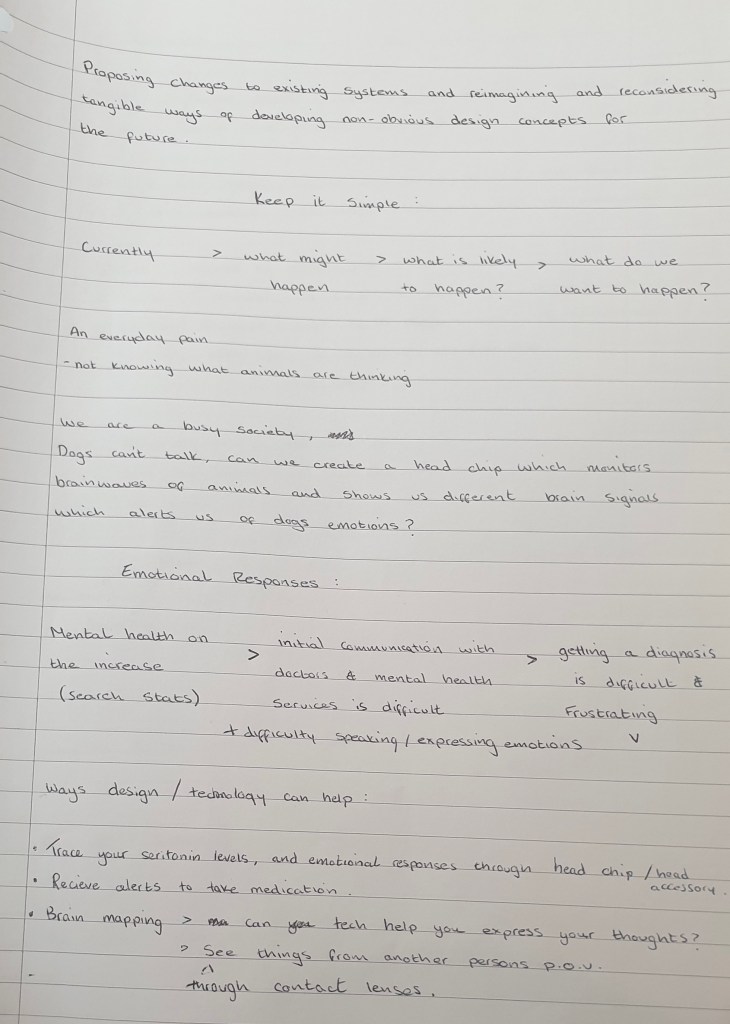
The Problem
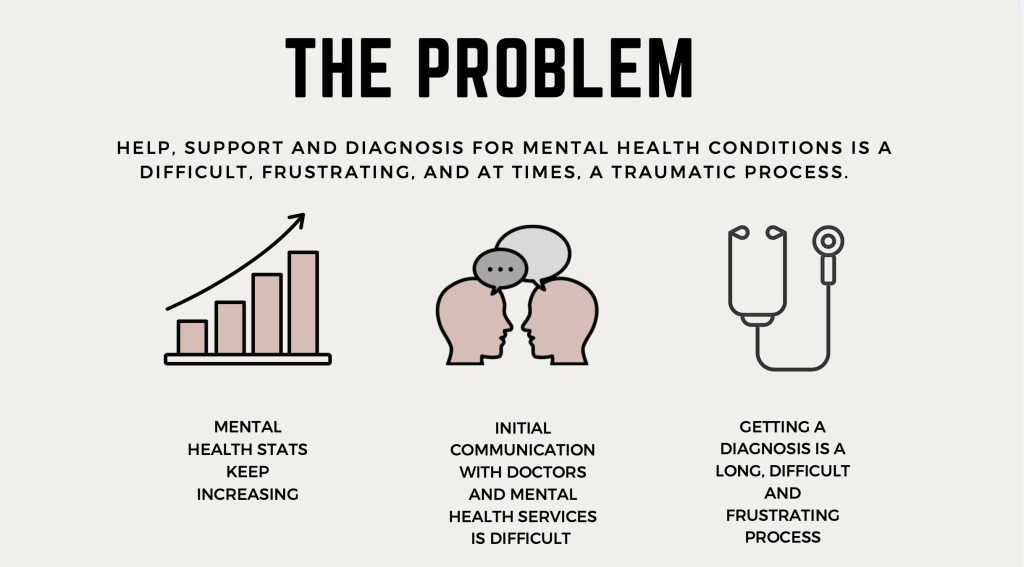
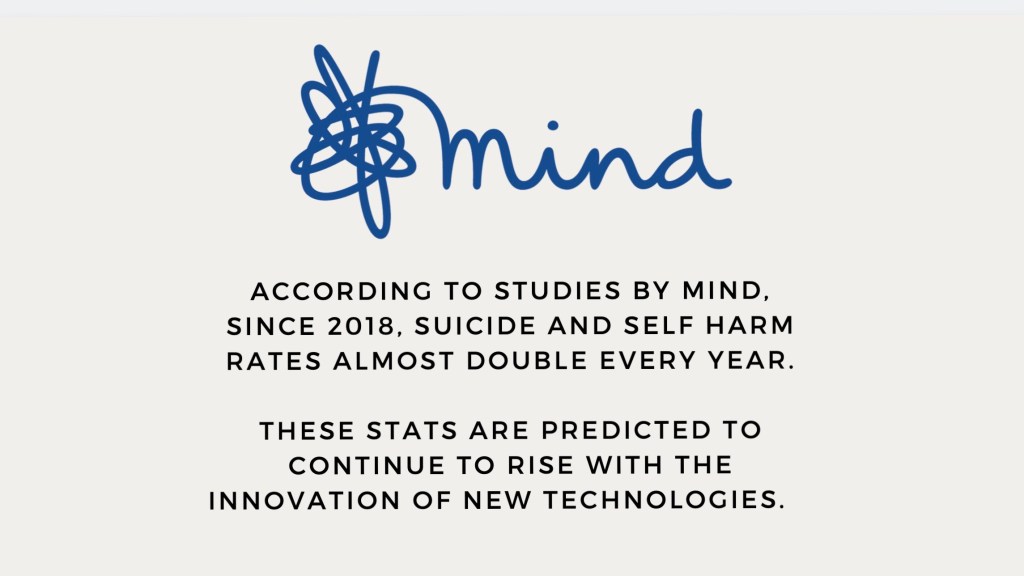
Mental health is becoming an increasingly explored topic in many areas, including design and technology. According to Mind, females aged between 16-25 are more likely to suffer from mental health problems. But why? My conclusion is that this age group spend more time of social media. With technologies advancing, we are spending more and more time online, and for this age group, that may be a bad thing.
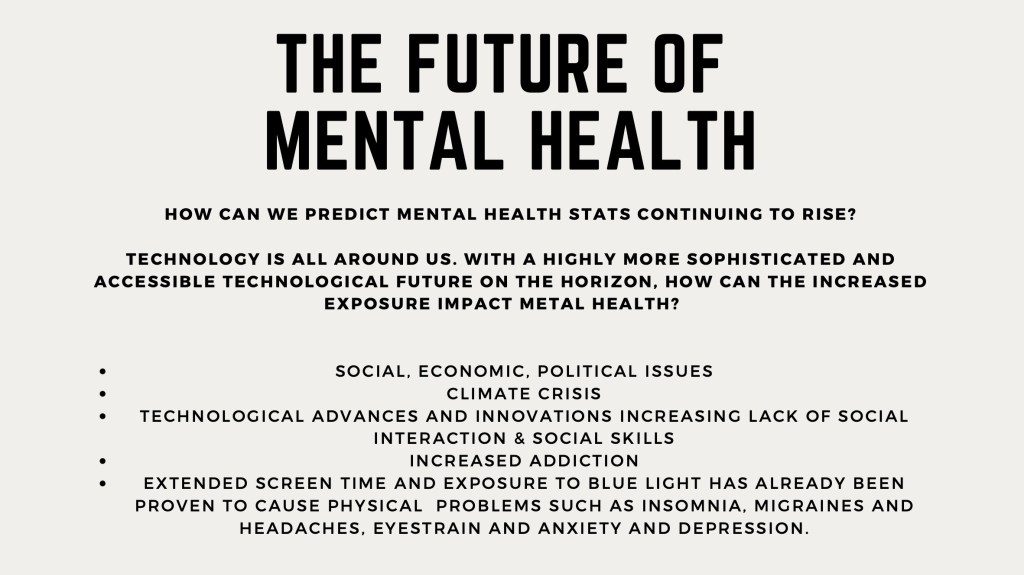
The link between mental health and social media/technology has already been proven to have a negative affect on people’s mental and physical health. Extended screen time has been proven to cause anxiety and depression due to social isolation and the loss of effective social skills. As well as problems with sleep, migraines and eye strain.
The future is technological. We won’t stop innovating, so how can we use technology to help mental wellbeing?
Communication with doctors and mental health services is something I myself have and am struggling with. The diagnosis process is something I, like many others, find long, difficult and extremely frustrating.
Solution:
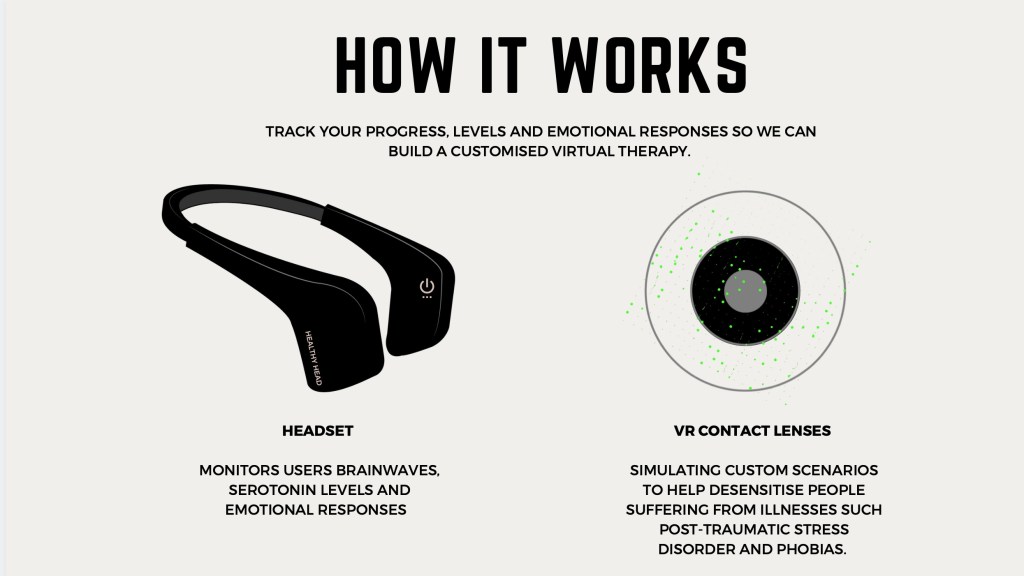
My answer is to use technology to help, support and diagnose mental health conditions from home. Essentially, I am designing a Headset that monitors brain waves, serotonin levels, and emotional responses. From this, a Virtual Reality contact lens simulates custom scenarios to help desensitise people to events/circumstances/situations which would trigger an intense emotional response. This kind of technology could not only be useful to people with mental health disorders, but could also help with the rehabilitation of criminals, addicts, and more.
Research
Introducing…
How it works
Outcome: 1 minute video (link below)
Reflection:
Before this brief, I had never heard of Speculative design, and felt extremely out of my depth. However, upon researching, I became fascinated with the concept, and would like to pursue this path/concept in other projects. The idea of predicting the future and creating something that may be extremely beneficial is not only fascinating, but fun.
I was inspired by my own struggles and frustrations with metal health to create Healthy Head. This is a product I believe could benefit many people now, and in the future. Mental health isn’t something that will just disappear in the future, it is something that statistics show is progressively getting worse.
Creating something that could diagnose and treat people in their own home is not only convenient, but it could actually decrease suicide rates, particularly in men. Men have the highest suicide rate, and this is widely believed to be the fault of toxic masculinity, gender stereotypes, and societies expectations of men. Men suffer in silence; a product like Healthy Head could take away the shame and embarrassment men feel about their mental health.
Overall I enjoyed this brief very much, and would improve in the future by creating a prototype of how this product would work. Perhaps even creating a mockup video of the Virtual Reality imagery the user would be able to view.
 Nadya Cheetham