Courtney Mehmet | Nadya Cheetham
Disney has been an important part of millions of childhoods for decades. Many of us grew up watching Disney films and programs in the 90’s and early 2000’s, when television and films became more accessible to everyone. Our aim is to create a hyper-relevant brand that will be targeted at 16 – 30 year olds from Europe, Africa and the Middle East from all social economic backgrounds. We will turn 90’s and 00’s Disney nostalgia into a campaign that will have lifelong relevancy to the generation that has spending power. We researched the importance of Disney to our target audience’s childhoods and the importance Disney has to their lives now. We also researched the Disney brand from the 90’s to 00’s in order to gain a deeper understanding on how to engage our target audience by using nostalgia. To resolve the challenge we are appealing to the idea of nostalgia and the Social Media and binge watching generation. We will be focusing our campaign on rewarding binge watching by offering exclusive Disney filters, Disney+ icons, sneak peaks and Disney Store discounts. Disney filters would be posted across Social Media platforms such as Instagram, Snapchat, and Tik Tok this will all be a part of a campaign to promote a nostalgic Disney Pop Up Cinema for Disney’s 100th anniversary.
Research
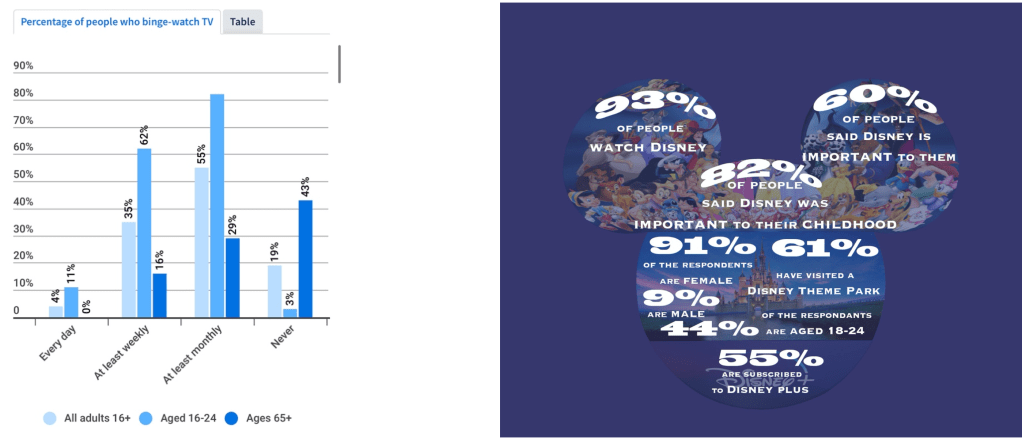
In order to understand how Disney is relevant to the lives of adults who grew up with Disney, we began our research by making a survey for our target market. There was a gender bias with the survey as 91% of respondents were female and only 9% were male. Most of the respondents were UK based but there were replies from people from around the world.
We are focusing on the Gen Z generation, who are heavily active on social media and streaming sites, so these platforms will be the most effective way of reaching this age group. 55% of our survey respondents are subscribed to Disney+ and the most common answer when asked why was that Disney brought back fond memories of the consumers childhood. The behaviour of this generation is that they consume information, brands and ideas through Social Media; YouTube, Instagram, Snapchat, Tik Tok being the most popular sites. They are also a generation that believes in instant gratification (receiving likes and reactions being the top reward) to solve this, our idea is to reward Disney+ users for something that they already do, binge watching. It has been reported by Statistica that a study held in 2019 showed that16-24 year olds are most likely to binge watch a show, with 82% reporting that they do it monthly.
Disney has relied on nostalgia for decades to appeal to its target audience by creating theme parks, live action shows and beautiful remakes of classic 90’s films. With crisp and realistic CGI in remakes, Disney have appealed to the tech obsessed Gen Z audience while keeping nostalgia. Disney is family based, which constantly ignites the passion of a new generation of fans as parents who were children in the 1990s take their own children to see the movies. In addition, Disney brings families together by many families having Disney movie nights and family holidays to the Disney Parks, which appeal to both the younger and older generations.
From our research we confirmed that Disney is still important and relevant to us in our adult lives due to the lessons it taught us as children, the nostalgic feeling it gives us and the fact that Disney is visual and available now to stream on demand. This research showed that even as adults we are able to engage the target audience with Disney as it still holds an important part of their life.
Personas

Problem
The problem that we are facing when appealing to our market is the misconception that Disney is just for children. We need to reach our audience on platforms that they use most, with rewards that cater to their consumer needs and show them that Disney is creating something specifically for them. Many people think that Disney is only important to them because of their childhoods. We need to show them how Disney can be relevant to them now and throughout their lives. We need to be able to use their nostalgia to show them how important Disney can be to them in the present and not just how important it was to them in their childhoods. To engage this generation, the approach needs to be media based, in order to reach them through Social Media and cater to their consumer needs. A big problem with this generation is the need to stand out and show on Social Media how fun and important their lives are, this is shown by exclusivity, something that they can show they have or an event that they attended that not everybody could have the chance to go to. They have a ‘Social Media’ ego, this is beneficial to a brand trying to engage them and why Pop Ups and exclusive events are so popular. They are also large consumers of products and we need to find a way to make them buy products without forcing ideas of consumerism and advertising products.
Objectives
Specific:
To turn well-loved 90’s and 00’s Disney nostalgia into outdoor Disney Cinemas within 16-30 year olds in Europe, the Middle East and Africa.
Measurable:
Amplifying the reach on socials using the hashtags #DisneyBinge #DisneyCinema as well as increased numbers of subscriptions and ticket sales.
Achievable:
An already well-established brand with a large following and variety of owned media. With a pre-existing community, our aims have been made more achievable.
Realistic:
An outdoor cinema is a cheaper alternative to an indoor space. With land renting expenses, projectors/screens and Disney themed kiosks, money will come back through ticket sales and increased Disney Plus subscriptions.
Timely:
A drive in/outdoor cinema reflects nostalgia from before our time, and is a fun activity to do when you’re young with friends and family. We believe these events will make Disney more relevant to the lives of the adults today. We want to show that Disney can still hold an important part of adults lives and help make memories in the present and not just the past. In regards to the timeframe, there is enough time to organise several outdoor cinemas as well as the Disney Binge reward scheme.
Tactics
We will be using paid media to advertise binge watching rewards on Disney+ through social media platforms including Instagram, Snapchat, Facebook, Tik Tok and YouTube. These rewards consist of unlocking exclusive Disney filters (Disney characters/advertising for the Disney Cinema) and exclusive Disney+ icons, sneak peeks of not seen before footage, throwback videos, discounts for the Disney store ranging from 5% to 25% off and lastly, VIP Tickets to the Disney Cinema. These rewards will be accessible to 16-30 year olds with Disney+ who watch at least 5-10 hours a week. Disney+ will be able to monitor ages and screen time effectively and reward on a ‘luck’ basis.
We will make use of owned media to keep current fans interested by advertising Disney Cinema on Disney+ and all social media platforms. On our owned media platforms, we will upload short clips from nostalgic movies to spark an interest in Disney Cinema. We will also do weekly uploads of quotes and scenes from nostalgic Disney movies where our followers will have to guess which movie it is from or fill in the blank in the quote. Every week there will be a countdown video to the opening of Disney Cinema to spark excitement within the community.
To spread the word about Disney Cinema, we will rely on earned media as well as paid.
With the fun exclusives available, people will be sharing their rewards across all social media platforms and starting a trend by using exclusive Disney character filters and hashtags.
Measurement and effectiveness:
Our customers are those who liked Disney as children, but don’t feel that Disney is part of, or necessary in their adult life. To appeal to these potential customers, our campaign will play on their need to relate back to their childhood, giving the consumer the comforting feeling of nostalgia.
Our brand awareness will be measured by how many people have viewed and clicked on our paid social media advertisements and the use of the exclusive hashtags as well as the traffic flow and following on owned media accounts.
Sign-ups will be measured by confirmation emails/texts and the amount of people who begin to binge-watch to get the rewards offered.
Online ticket sales will be monitored to measure event attendance. In addition, interest in the event will be monitored based on how many people save or bookmark the event on social media platforms. Customers who have already displayed an interest in the brand and event will receive push notifications when signed up through text, email, Facebook, and Instagram to remind them of low/limited ticket numbers available.
We will keep count of the volume of tickets being sold for Disney Cinema and the amount of profit made from ticket purchases and Disney+ subscriptions in specific areas to measure our sales metrics.
Social metrics will be measured by the amount of views on adverts which will displayed on YouTube, Instagram, Facebook, Tik Tok and snapchat. Instagram reach will be measured by the use and views of the exclusive hashtags and new followings. Other methods we will use to measure social metrics include email sign-ups and new Disney+ accounts and registration, as well as the amount of clicks to the campaign landing page.
Return of Investment On Campaign
Budget- 100K-1m
Costs: Ads, land rental, food and drink, electric and water bills and merchandise.
ROI is important to measure the amount of profit on an investment. With a pop-up cinema, we have kept costs lower than an indoor venue. Our costs will include, land rental, electricity bills, food and drink carts with Disney branding, seating, VIP seats, screens, projectors, staff such as security, film crew and food and ticket staff, speakers and special effect accessories such as 3D glasses and even headphones for people who speak different languages.
Potential Implementation and Moving Forward
Our next steps to take this proposal forward would be to see how much interest is in this campaign idea. We can get an estimate of how many people would be interested in the event by doing surveys, given to our target market. To prompt people to take part, Disney can offer a 10% discount on the customers next months Disney+ subscription.
We aim to create a Minimum Viable Product which will be low cost and effective in reaching out to the audience. This will help us measure the reaction and interest in our campaign within our target market and allow us to test our idea with potential customers before committing a large budget to the product’s full development. It can help us see whether our idea and product is of interest to people and can help generate feedback that can help our future product development.
For our MVP, we feel a short advertisement video will be effective to gain knowledge on where to go next. This video will explain what our product is and what we are offering to customers. This will be effective to understand and measure the interest of the campaign and give us a better understanding of any changes and improvements that need to be made. The video will be uploaded to a landing page and social media platforms to monitor the amount of views and clicks on the ad.
Conclusion
The research showed that our target audience are avid binge watchers and love Disney, our idea of a Disney Plus binge watching reward scheme this solves the problem Disney have with appealing to that generation as it is an activity that they already partake in. The objectives of the Disney Cinema also solve Disney’s challenge of creating something that will celebrate their 100th anniversary and appeal to ages 16 – 30 from Europe, the Middle East and Africa because it creates new memories of Disney for an older generation that relies on nostalgia to keep Disney important and relevant to them. Our marketing tactics using paid media, owned media and earned media through using Disney Plus and Social Networking platforms solves the problem of reaching our targeting audience as these are the platforms that are most popular with the targeted age range.
 Nadya Cheetham