My boyfriend Kieran joined the Royal Marines as soon as he left school at the age of 17. Royal Marines training is 32 weeks long and Kieran unfortunately received a massive blow with a severe hip injury during his final exercise before Pass Out. After months of being in the Rehabilitation Centre on Camp known as Hunter Company, Kieran made the hard decision of leaving his life in the Marines before receiving a Medical Discharge, which would have ended his Military career and possibility of rejoining any Military Force.
After a few years back in civilian life, Kieran re-joined the Royal Maines at the age of 22. For as long as I have known Kieran, he has never been happy living a civvy life.
My Creative Manifesto is to explore metal health within men in the UK Military. To understand this subject on a personal level, I will begin to look at how mental disorders in the military first became recognised and will research behaviours and attitudes within military personnel who have struggled with mental health. I will link my findings to Kieran’s behaviour and follow his Military career from start to present and speak about any signs of mental strain he has experienced.
To begin with, I feel it is important to understand when psychological struggles first became apparent within Military personnel.
During WWI, the British Military were faced with a confusing and pressing problem which was affecting frontline troops. Increasing numbers of British Soldiers were displaying strange and unexplainable behaviours and symptoms with no visible or obvious physical injuries, including fatigue, tremors, severe confusion, nightmares and impaired sight and hearing. British Military Doctors were struggling to understand and treat the disorder, named by the Soldiers as “Shell shock”. In an effort to better understand and treat the condition, the British Military turned to psychology to find an answer.
Charles Myers became a consulting psychologist to the British Expeditionary Force to offer opinions on cases of shell shock. In 1915, Myers wrote the first paper on shell-shock and theorised that the symptoms being experienced by soldiers most likely stemmed from internal physical injuries. He believed that repetitive exposure to blasts on the frontline caused brain trauma that resulted in this strange grouping of symptoms. Myers soon found out that his hypothesis didn’t hold up, as there were plenty of veterans who had not been exposed to the concussive blasts of trench warfare who were still experiencing the symptoms of shell shock. In addition, not all veterans who had seen this kind of battle returned with symptoms.
Eventually, Myers concluded that the symptoms being experienced by soldiers were psychological rather than physical casualties, and believed that the symptoms were manifestations of repressed trauma. Myers believed that shell shock could be treated and cured through cognitive reintegration, along with another psychologist, William McDougall. They believed that a shell shocked soldier would experience these symptoms due to an attempt to manage a traumatic experience by repressing memories of traumatic events.
Many young men suffering from shell shock were shot and killed for military crimes including desertion and cowardice. The Military recognised that war could cause men to experience psychological break downs, however a lasting episode was seen as a weakness and a symptom of a lack of character. A stigma of mental illness quickly became widespread in the Armed Forces and many senior officers, such as Senior British Army Officer, Lord Gort, argued that shell-shock ‘must be looked upon as a form of disgrace to the soldier’.
We now know that what these combat veterans were facing was likely what today we call Post Traumatic Stress Disorder. We are now better able to recognise it, and treatments have certainly advanced, but we still don’t have a full understanding of what PTSD is.
At the age of 17, and, after thirty weeks of adapting to the military lifestyle and mindset, Kieran was thrown back into a world he did not want to be in, civilian life (referred to as “Civvy street” by military personnel). From joining the Marines straight after completing his GCSE’s, he was set on joining the forces from the age of 14. His discharge meant a big blow for him, and suddenly all his plans had changed. To find his feet, Kieran had to quickly find housing and a job to keep him afloat. He got a job working in a local bookmakers and lived sofa surfing at friends houses until he found someone looking to illegally sublet in the local area. Once moved in, Kieran kept his job and enrolled in the local college, where I was also attending. I had met Kieran in the smoking area at our college and was instantly fascinated with the stories he had to tell about his life in the military. Due to his discharge, Kieran was lost and extremely unhappy, with no other plans for the future.
During the course of our friendship, I knew that Kieran enjoyed a few pints at the end of a long day, and never thought much of it, until friendship developed into a relationship. I started staying at Kierans sub-let room and began to notice a very high alcohol intake. Kieran on many occasions would wake up in the morning and casually reach for the bottle of Jamesons Irish Whiskey he used to keep by his bedside. I didn’t ask any questions in order to avoid upsetting him, until I noticed a coffee flask in his work backpack which was also filled with whiskey. I asked him about it but received nothing more than a shrug of the shoulders, so I didn’t press on.
Statistics by the UK Government have shown that the rate of alcohol intake is significantly higher in Royal Maines, this is a clear indication to me that Royal Marine Commandos are using alcohol as a coping method for any psychological struggles.
Three months into our relationship, Kieran and I decided to move in together in a small apartment in a nice area of town. During the time we spent living together, I noticed a significant drop in his alcohol intake, but didn’t want to make him aware of it in worry that he would revert back.
We were sat with a few bottles of wine on the sofa one evening after we had both finished a long day of work, and I gained the courage to ask him about his feelings after his discharge. I spoke honestly about the worries I had about his drinking habits and had a long chat that night. Much to my surprise, Kieran told me that he had never realised how much he depended on alcohol until we had moved in together. He explained that living together gave him a purpose, something he hadn’t had since he was in Marine training. To me, this meant that all he really needed was stability and structure, something he hadn’t really had in his childhood, but found in his life as a Royal Marine.
When Kieran turned 22, he sent off an application to re-join the Marines, five years since his discharge at age 17. A year after we had moved in together, Kieran left to give his second chance of fulfilling his goal to become a Royal Marine Commando. He was extremely excited to return to the lifestyle he so desperately loved. As his girlfriend, I was of course upset that I would not see him for weeks or months at a time, however the thought of him doing something he loved and was passionate about gave me peace.
Kieran is currently still in training, after being back trooped a few times and spending time in sick bay. He is doing incredibly well in his training despite a few set backs being thrown his way, and, of course, I am extremely proud of him.
Most recent Statistics from 2017/18 show that Royal Marines have significantly lower rates of ill mental health than other Military Services. This surprised me as Royal Marines see more active service and more intense and longer training than other Services. Kieran has told me that the Royal Marines have launched a new initiative called Project Regain which is designed for Royal Marine Commandos to seek necessary help. This Project may have been so successful that Marines are relying on this rather than seek for support elsewhere.
Since re-joining, Kieran has never been better in terms of physical form and general mental health while on camp, however I have noticed changes in his behaviours when back home on civvy street.
I feel it is important to keep in mind that due to leaving the Royal Marines previously, Kieran has done over 64 weeks of intense, physical and mentally demanding training instead of 32 like most recruits. This length of time in training is bound to have some physiological impact.
The most well known trait of military personnel is “The Switch”, which refers to the ability of having controlled anger and aggression, as well as the frequent change of mindset from Civilian to Royal Marine Commando and vice versa. Kieran is easily able to switch from Civilian to RMC but struggles the other way around when he is on leave. He has adapted to the Military lifestyle like a fish to water, however struggles to change his mindset when he is in Civvy street. When back in civilian life, Kieran displays a low tolerance for things not being done quickly, efficiently and/or properly, which causes him to speak his mind and appear aggressive and rude to others. This can sometimes be quite upsetting to witness, as fights and altercations usually break out, and a big misjudgement of Kieran’s character to others. I of course know that this is how Kieran has been taught to deal with things so I am able to take this with a pinch of salt. Others however, are very quick to take offence or get angry to Kierans blunt approach.
These forms of communication, and overall lifestyle work very well in the Military, but in civilian life, we take offence to blunt approaches and shouting commands to others is not an effective way of communication. As I have explained, Kieran’s low tolerance and blunt way of speaking causes many issues when he is off camp. Regularly fights break out in pubs between the recruits and civilian lads when the troop go into town on their Saturday nights off.
Around six or seven months ago, I noticed Kieran had started speaking in his sleep, which was completely new behaviour. When I brought it up the next morning, Kieran had no idea he had stated doing this. A few months later, Kieran spoke to me about experiencing nightmares, which causes him to shout, kick and punch things in his sleep. He explained to me that when this happens he doesn’t wake up, but his troop mates wake him and ask if he is okay. The first time I experienced an episode like this terrified me, and after witnessing these episodes for a month or so they began to happen when he was awake. When awake, Kieran would start shouting and pacing the room but his words would make little to no sense. When this happened, I had no idea what was going on and was very upset that this was happening to him. When Kieran has an episode, he is unable to hear anyone around him so it is very difficult to help him. Over time, I have learnt that when experiencing an episode like this, Kieran only responds when I gently hug him and speak quietly. After he has calmed down, he has very little recollection of what just happened. Me and Kieran do not know what has caused this behaviour and Kieran is very reluctant to speak about it.
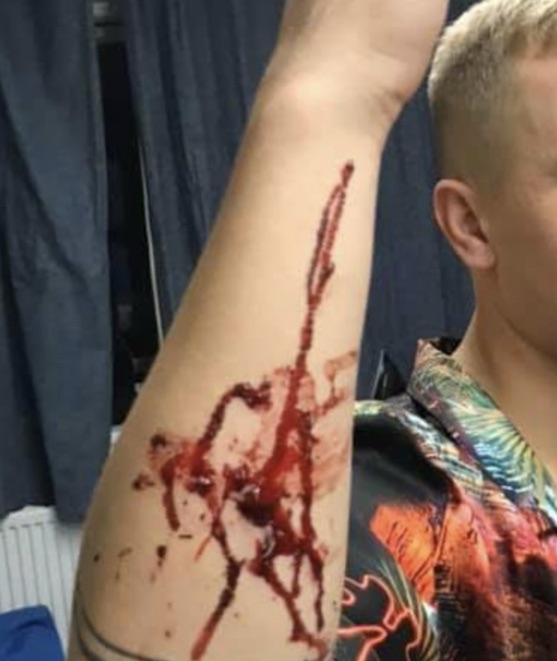
Knowing Kieran, I don’t think he will seek help, no matter how hard I push, which is what has inspired me to look into this subject of mens mental health in the Military for my Manifesto. Kieran’s troop mate locked Kieran in a telephone box as a joke while they were off camp. Kieran had an episode as explained above, and punched his way out through the glass, severely cutting his arm. He now has deeps scars on his arm which are around 6-8cm long.
Kieran and our mutual friend Ben were both in troop with fellow recruit Ethan Jones. Kieran and Ben were in the Rehabilitation Centre on Camp known as Hunter Company with minor injuries from a training exercise are were later put into a different troop due the the training they missed while their injuries were treated. Ethan and the rest of the troop were practising an assault from a landing craft on Tregantle beach in Cornwall, when he went under the water. According to news reports, Ethan was immediately taken to hospital where he died the following day.
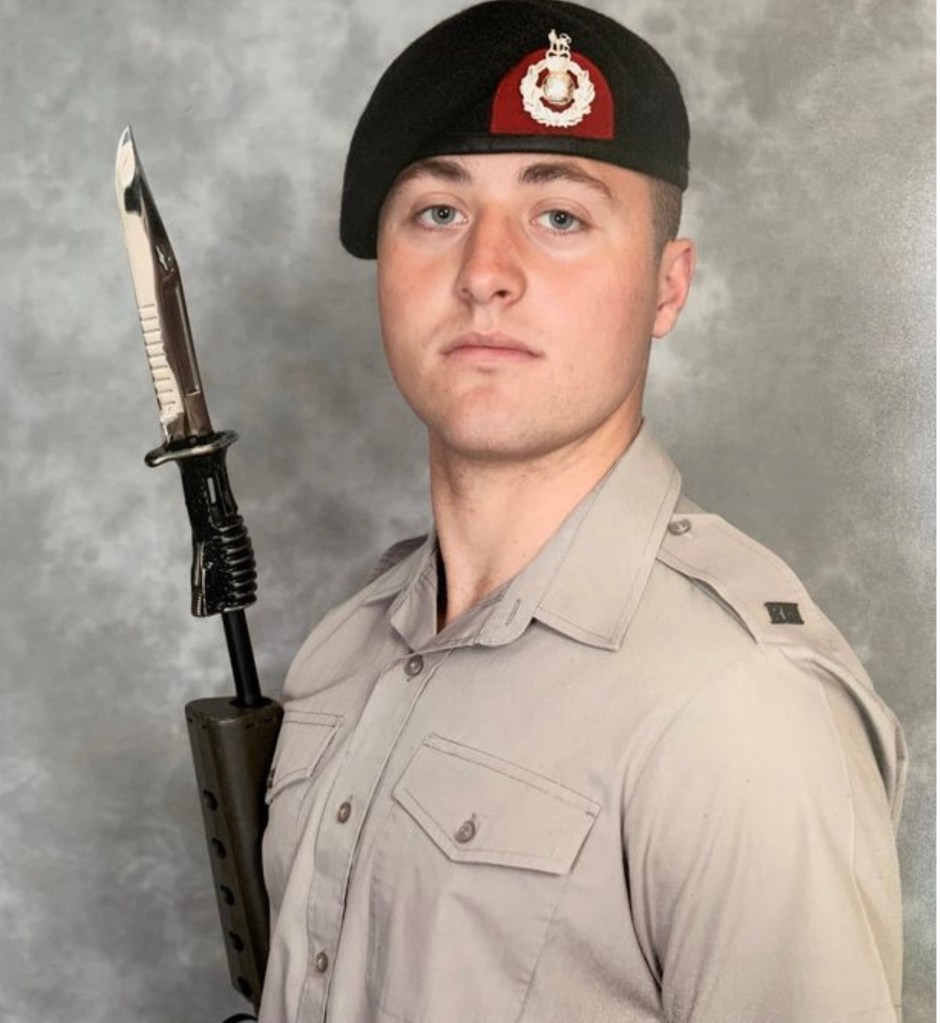
When Ethan had died, the story of his death travelled around camp and Kieran and Ben were devastated to have lost such a good mate. According to Ethans troop mates who were on the nighttime exercise with him, Ethan had jumped out of the craft as instructed to do, with approximately 55kg of additional weight including his burgeon, rifle and ammunition when he went underwater and couldn’t be located. At around 1am in the morning in such a remote area, Ethan couldn’t be seen for several minutes. A troop mate noticed Ethan in the water and immediately jumped into the water and pulled him to shore where he attempted CPR. Ethan was then taken to hospital and was in critical condition for less 24 hours before he passed.
Ben has described Ethan as “One of the quieter lads in troop, but not in a recluse way, more that he just got shit done and absorbed it all.” Ben has also told me that Ethans death has effected the entire troop. Kieran told me that Ethan was mates with everyone and would always help people out on training exercises. Both Kieran and Ben were on a survival training exercise so were unable to attend their previous troop Pass Out Parade which also included a memorial service for Ethan.
From personal insights and extensive research, it has become apparent that mental health among male Military personnel is a pressing issue, and has been since the First World War. Although my research has shown that Royal Marines have lower rates of ill mental health than other services, I believe through personal insights that it is likely mental health among Royal Marines is either the same or higher, because less personnel are seeking help. I feel that through advertising, we can help Royal Marines seek necessary help and eradicate the stigma of mental health in military personnel. Project Regain has clearly been a huge success with Royal Marines and I will further analyse their methods and apply them to my own forms of advertising through the means of posters and magazine.
 Nadya Cheetham