My boyfriend Kieran joined the Royal Marines as soon as he left school at the age of 17. Royal Marines training is 32 weeks long and Kieran unfortunately received a massive blow with a severe hip injury during his final exercise before Pass Out. After months of being in the Rehabilitation Centre on Camp known as Hunter Company, Kieran made the hard decision of leaving his life in the Marines before receiving a Medical Discharge, which would have ended his Military career and possibility of rejoining any Military Force.
After a few years back in civilian life, Kieran re-joined the Royal Maines at the age of 22. For as long as I have known Kieran, he has never been happy living a civilian life.
My Creative Manifesto is to explore metal health within men in the UK Military. To understand this subject on a personal level, I will begin to look at Kieran’s Military career from start to present and speak about any signs of mental strain he has experienced. Along with my findings I will also do concrete research and present any evidence that will help me understand Kieran’s mental wellbeing, including behaviours, attitudes and personality traits common in Military Personnel who have struggled with their mental health.
For this project, we have ben asked to create a cultural manifesto. The components of this project include the following:
- Word Document with text chosen by student
- At least x1 Blog Post with 1500 words, including media (images)
- 10 Minute Video with documentary style explanation of the significance of cultural manifestos
- Research Portfolio
- Instagram Photos
- Tweets
- Vision Board
- Sketches
- Conceptual Experiments with Artefacts
In addition to these components, we have been told to create our manifesto based on a subject we are passionate about. For me, this meant making it personal. I always create my best work when it is based on something I really care about, so, for my cultural manifesto I will be focusing on mens mental health in the UK Military. I have chosen this subject as my boyfriend is currently a Royal Marines Commando. Seeing the impact of training and deployment first hand has inspired me to research and create a manifesto of the mental impact the Military has on serving personnel.
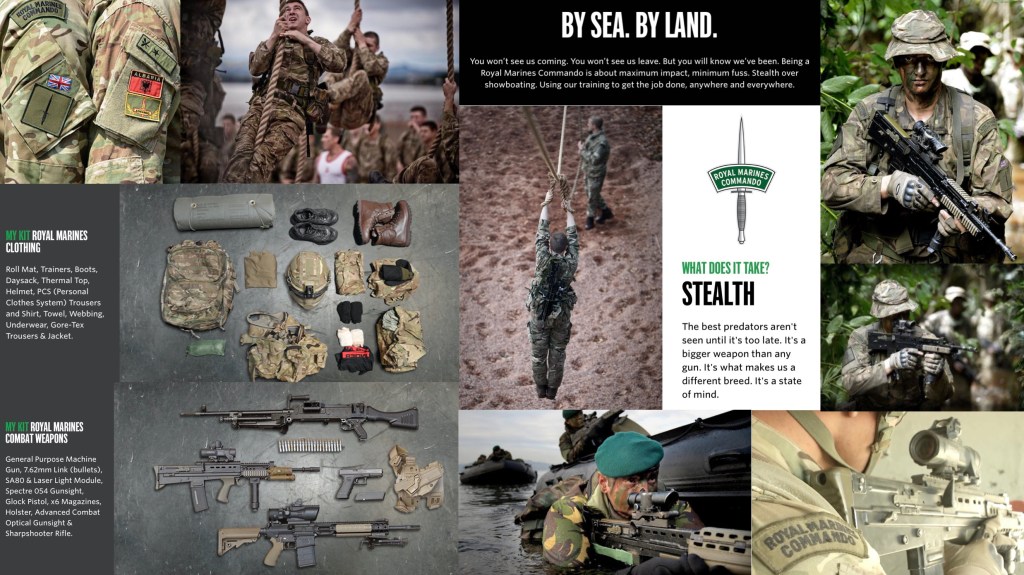
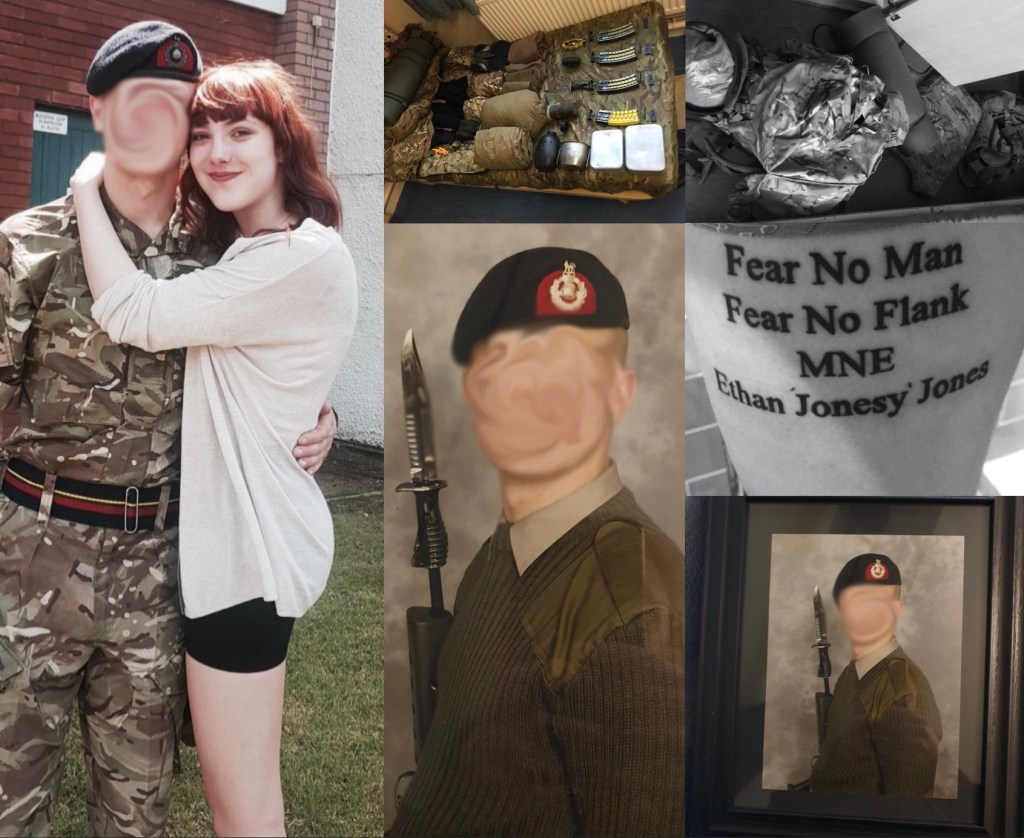
To begin with, I have created two mood boards to kick start my research and ideas. The first mood board consists of generic images of the Royal Marines, depicting their everyday life, while the mood board below are personal photographs either taken by me or sent to me from my boyfriend while training or on deployment. I felt that two separate mood boards would give me a better idea of where to begin and maybe highlight any differences of what the public see, and the reality. My own images are also here for me to reference back to and keep in mind to keep referring to personal experiences. For security reasons, I have had to blur Kieran’s face from photos.
Checklist for Research:
- What historical narratives inform your choices to create?
- What human themes are relevant?
- What do your personal experiences bring, that makes a difference and is valuable?
- What is the point of creating?
- Why are ‘manifestos’ worth doing?
- Who are the movers, shakers, thinkers that inform the way we think, see, do and behave?
- Why should you care?
- Why does creativity and the cultural matter?
- Who are other people who have done creative work and are important for cultural heritage?
- Who are you making things for? Who should your audience be?
- Whose point of view is worthy?
- Who should pay attention to what you want to do with your life?
- Where does culture happen?
- Where is culture not happening?
- How does cultural change happen?
- How are you applying yourself?
- How do other people do it?
Response to research checklist:
The historical narratives that will inform my choices to create in this project are The First World War, Mens mental health & stigma, which I will be specifically looking at Cowardice in the First World War and Shell Shock. I will be paying close attention and research to the Military Lifestyle, both historical and present, including social stigma around mens mental health, particularly in the Royal Marines, which is an example of a very tough, masculine environment.
By bringing my personal experiences into this assignment, I aim to make people more aware of the effects and struggles PTSD and other mental health issues have on Military personnel and the people close to them. My personal experiences make this topic a reality, not only to me, but hopefully to others who read it; it’s not just a story. The point of creating my cultural manifesto is to try to make people aware of the issue, which I feel is important, in the hopes to inflict change and awareness.
My interpretation of a Manifesto is a written document and/or discussion to help shape culture and behaviours within a group. As previously discussed, my manifesto is to make people aware of the psychological difficulties men face in the Military to help eliminate stigma and to initiate a support system to give Military Personnel the encouragement to seek help.
The movers, shakers and thinkers that I will be looking at to help inform the way people think, see and behave towards my manifesto are as follows:
- Charles Samuel Myers, ‘A Contribution to the Study of Shell Shock’, The Lancet, first military psychiatrist to help with PTSD
- Veterans who are available most days on camp to speak to struggling personal – offer to have a chat with a cup of tea.
- Royal Marines Charity – offer support
- Project Regain – offer help and support
I feel that people should care about the subject of my manifesto as UK Military Personnel are responsible for keeping us and our country safe. These young men risk their lives as well as their physical and mental wellbeing to help provide a secure and safe community for us. They deserve our support and respect. Due to the intense and difficult conditions, our Military Personnel need to be on their top form 24/7.
In terms of creative work, I will look at the official Royal Marines Adverts, as I feel they are a string example of creative work which successfully represent the Royal Marine culture. (Links below):
- https://www.youtube.com/watch?v=gF1F0urb8-w
- https://www.youtube.com/watch?v=KpvBH38WsNA
- https://www.youtube.com/watch?v=h5yQWK8h42U
The creative aspect of this project will be primarily targeted to Royal Marine Commandos who are experiencing psychological difficulties. Aimed at young personnel who are still seeing active service or are in the process completing their training. This is because young men are less likely to ask for help as they feel that they are not entitled to it due to not yet experiencing active service or knowing people who have “worse” symptoms or “a better reason” to be suffering than them. Due to this, the point of view from young Royal Marine Commandos on my project is very important as they are the ones who will receive the help and support.
Speaking in a cultural sense, Militarisation and adopting the Military Lifestyle, is a culture in itself. On camp, militarisation starts from day one and is enforced 24/7. Many people from around the world travel to Lympstone Commando to be part of the “Elite”, however their personal cultural beliefs and behaviours are left behind and they must adopt the Royal Marine lifestyle, discipline and attitude. Militarisation – The process of turning a civilian into a Royal Marine Commando (being an RMC is its own culture). Cultural change happens when Social and Cultural norms are challenged and ideas are spoken of and/or enforced. In the Royal Marines cultural changes happen when Officers and Commanders are unhappy and/or displeased with something and believe changes need to be put in place to achieve better outcomes in terms of performance, time management, discipline etc.
I will be applying myself to this project by including personal experiences and stories, making this project personal and meaningful. I will also be including first hand information and stories with Kieran and Ben, who will all play a big roll in this project. I will also speak about Ethan Jones, a close troop mate of Kieran and ben who has sadly passed away a month ago on a survival exercise.
Research Plan
To organise myself and my research, I have written a list to follow of essential research to keep on track.
- How did it begin? Look into Shell shock in WW1.
- What are the most common mental health issues experienced by Royal Marine Commandos in present time/ within the last few years?
- Statistics for above points. These can be found on the gov.uk website and through the Royal Navy website.
- What help is currently available for Real Marine Commandos suffering with psychological issues? For this I will speak to Kieran directly and research using the Royal Navy and Royal Marine Charity websites.
- Royal Maines Commando School Documentary
- Kieran
- First hand case studies – Ethan Jones’ death and how it has effected Kieran, Ben (tribute tattoo) and other troop mates. (Reeder who tried to resuscitate him)
- The effects on Ben who has recently been medically discharged (Tried to follow in his fathers foot steps and make him proud)
Shell Shock and Post Traumatic Stress Disorder
Post Traumatic Stress Disorder has been around for hundreds of years, but has been known by different names. In WWI PTSD was known as “shell shock’, during WWII, as “War Neurosis”, and during the Vietnam War, “Combat Stress Reaction”. It was in the 1980s when the term Post Traumatic Stress Disorder we know today was introduced by the American Psychiatric Association. So, how did it all start?
During WWI, the British Military were faced with a confusing and pressing problem which was affecting frontline troops. Increasing numbers of British Soldiers were displaying strange and unexplainable behaviours and symptoms with no visible or obvious physical injuries, including fatigue, tremors, severe confusion, nightmares and impaired sight and hearing. British Military Doctors were struggling to understand and treat the disorder, named by the Soldiers as “Shell shock”. In an effort to better understand and treat the condition, the British Military turned to psychology to find an answer.
Charles Myers became a consulting psychologist to the British Expeditionary Force to offer opinions on cases of shell shock. In 1915, Myers wrote the first paper on shell-shock and theorised that the symptoms being experienced by soldiers most likely stemmed from internal physical injuries. He believed that repetitive exposure to blasts on the frontline caused brain trauma that resulted in this strange grouping of symptoms. Myers soon found out that his hypothesis didn’t hold up, as there were plenty of veterans who had not been exposed to the concussive blasts of trench warfare who were still experiencing the symptoms of shell shock. In addition, not all veterans who had seen this kind of battle returned with symptoms.
Eventually, Myers concluded that the symptoms being experienced by soldiers were psychological rather than physical casualties, and believed that the symptoms were manifestations of repressed trauma. Myers believed that shell shock could be treated and cured through cognitive reintegration, along with another psychologist, William McDougall. They believed that a shell shocked soldier would experience these symptoms due to an attempt to manage a traumatic experience by repressing memories of traumatic events.
Many young men suffering from shell shock were shot and killed for military crimes including desertion and cowardice. The Military recognised that war could cause men to experience psychological break downs, however a lasting episode was seen as a weakness and a symptom of a lack of character. A stigma of mental illness quickly became widespread in the Armed Forces and many senior officers, such as Senior British Army Officer, Lord Gort, argued that shell-shock ‘must be looked upon as a form of disgrace to the soldier’.
We now know that what these combat veterans were facing was likely what today we call Post Traumatic Stress Disorder. We are now better able to recognise it, and treatments have certainly advanced, but we still don’t have a full understanding of what PTSD is.
Currently, around 4 – 7% of frontline troops will develop post-traumatic stress disorder (PTSD) and around 20% of service personnel are suffering with a mental health disorder at any one time.
Current Statistics on Mental Health in UK Armed Forces
From researching and reading through many different sites, it appears that Alcoholism, depression and PTSD are the most common forms of mental illnesses within the British Armed Forces. On the UK Government website, I have found some useful statistics to gain a better understanding of mental health within the British Armed Forces.
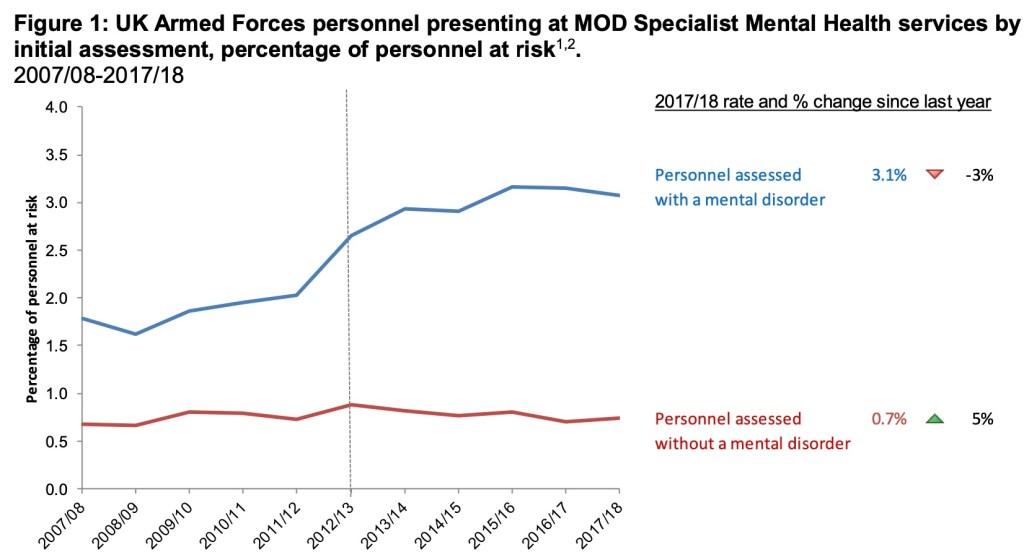
Firstly, I looked at how many service personnel were diagnosed with a mental health issue. The graph above shows that 3.1% of UK Armed Forces personnel were assessed with a mental disorder in 2017/18. The number of personnel diagnosed with a mental health disorder is much higher than those without, and, in addition the government say that 4 in 5 of UK Armed Forces personnel seen at the MOD Specialist Mental Health in 2017/18 were assessed with a mental disorder. This is an extremely high number of personnel who are seen and diagnosed, which for for me, raises the question if personnel wait until their mental health has gotten almost unmanageable before seeking any help?
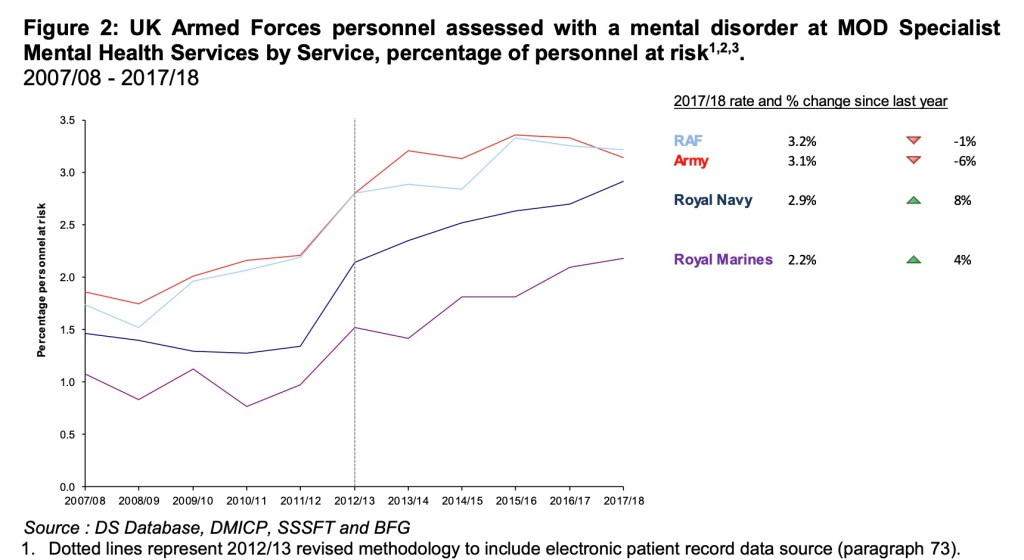
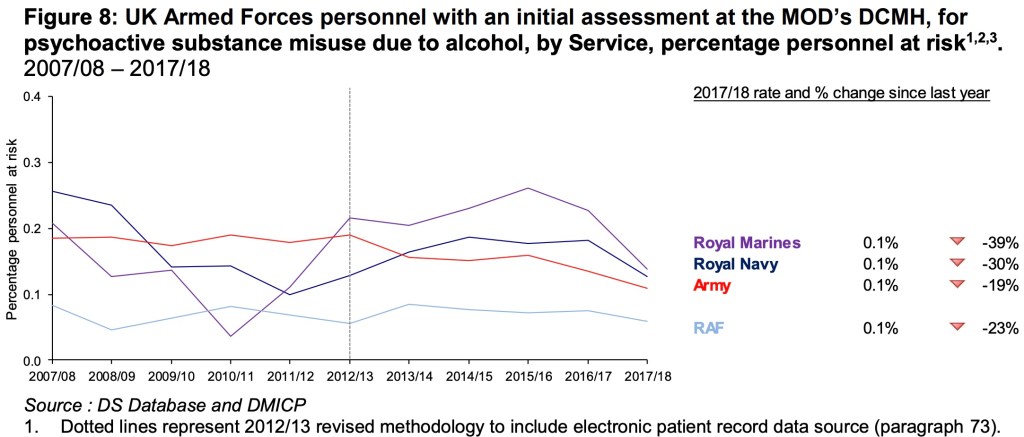
The second graph I looked at, showed the statistics of personnel assessed with a mental disorder by service. Interestingly, Royal Marines have significantly lower rates of ill mental health than other Military Services. This surprised me as Royal Marines see more active service and more intense and longer training than other Services. This information led me to investigate on why this may be. My boyfriend told me that the Royal Marines have launched a new initiative called Project Regain which is designed for Royal Marine Commandos to seek necessary help. This Project may have been so successful that Marines are relying on this rather than seek for support elsewhere. In addition to this point, I have discovered on further reading that the rates of alcohol intake are significantly higher in Royal Maines (Figure below). This is a clear indication to me that Royal Marine Commandos are using alcohol as a coping method for any psychological struggles.
From these findings, I have decided to further into Project Regain to see why it has ben so effective.
Project Regain
Project Regain aims to improve the mental health awareness of serving marines, allowing all ranks to receive a basic education about worrying symptoms and behaviours and to seek help. Regain aims to reduce the stigma and barriers to treatment and enable ranks to present themselves without fear of being labelled by peers or command.
Project regain had noticed that one of the greatest obstacles to effective treatment is the individual failing to recognise that they have a problem that can be treated to avoid negative outcomes, without detriment to their career. Regain aims to help sufferers identify a problem. Knowing how to seek help is also an obstacle which Regain aims to tackle.
Regain recommend that any recruits who recognise these behavioural changes in themselves or others, should seek help;
- Isolation and withdrawal (just sitting in your grot or replacing social activities with solitary activities)
- Feeling distant and cut of from friends and loved ones
- Constant relationship problems
- Being excessively aggressive and irritable
- Drinking excessively
- Neglecting work or a drop in professional standards
- Excessive phys
When these symptoms become a consistent presence:
- Low mood and mood swings
- Irritability
- Sleep problems
- Poor concentration
- Anxiety
- Nightmares or flashbacks about traumatic events
- Constantly feeling on edge or in danger
- Easily startled by loud noises
In addition to this, Project Regain also have self tests available on their website:
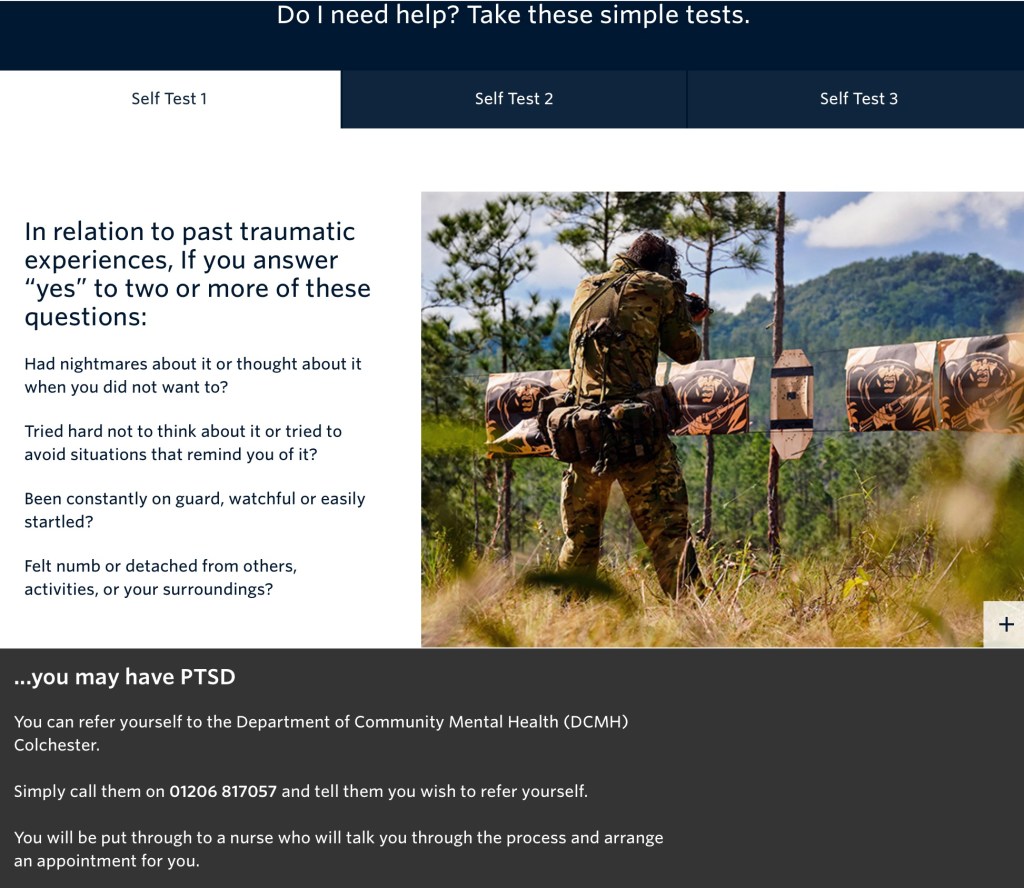
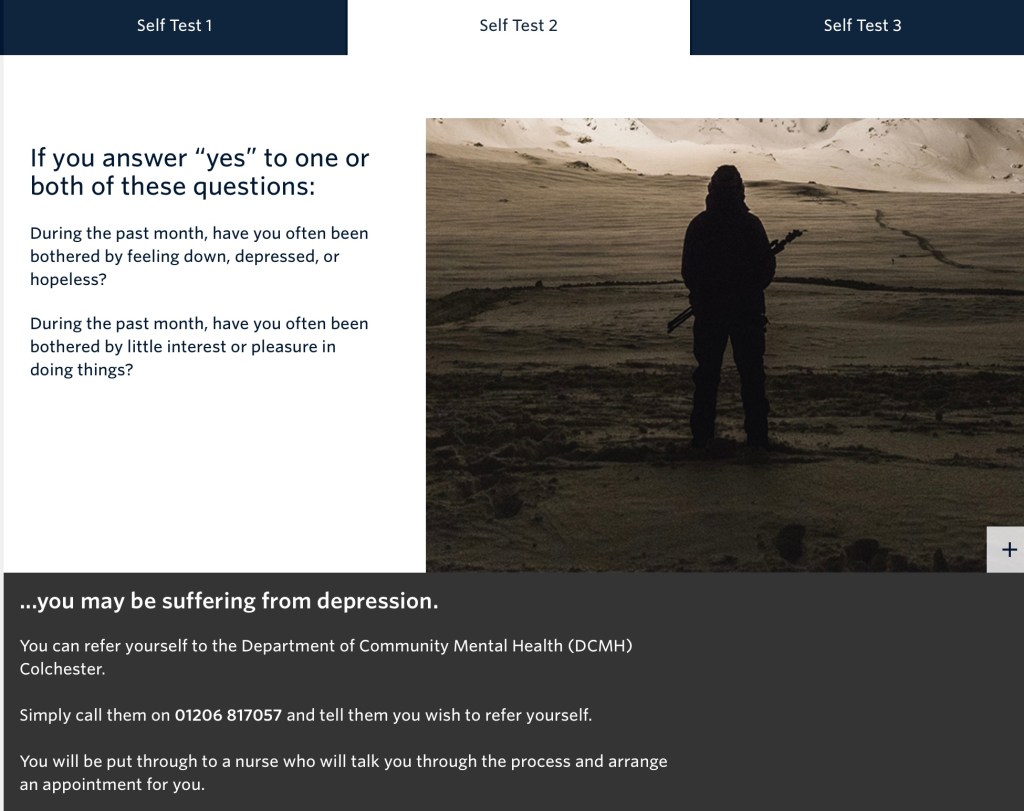
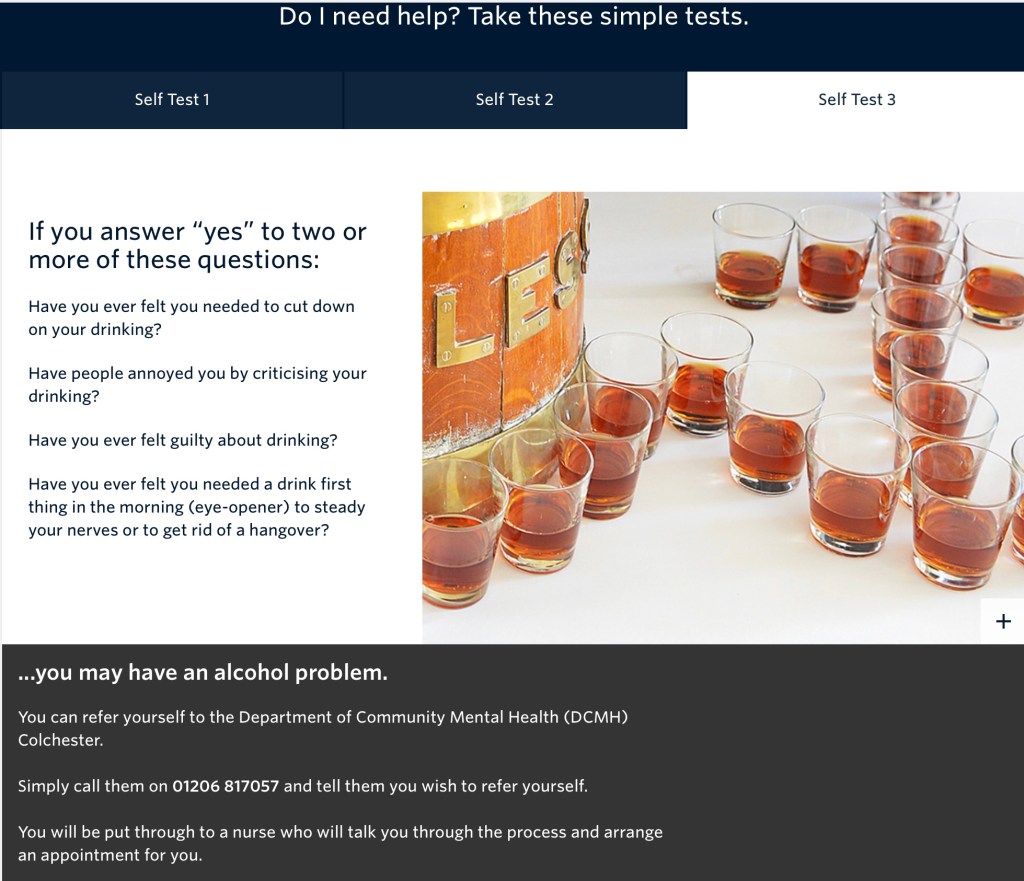
The Royal Navy website has a lot of clear and straight forward information available. The structure of the layout is very clear to navigate and is kept minimal. I think the self tests are a brilliant tool to get recruits on the right path of seeking help, as there is no record, they can do it themselves, and get a clear idea of what to do next. The overall page for Project Regain appeals to Royal Marines in particular due to the structured layout, which is something RMCs have on a daily basis (for example the “step by step process of seeking help”). They have managed to make something which is quite daunting into something familiar and straight forward and have tailored the project specifically to serving Royal Marine Commandos.
Royal Marines Commando School Documentary
Notes:
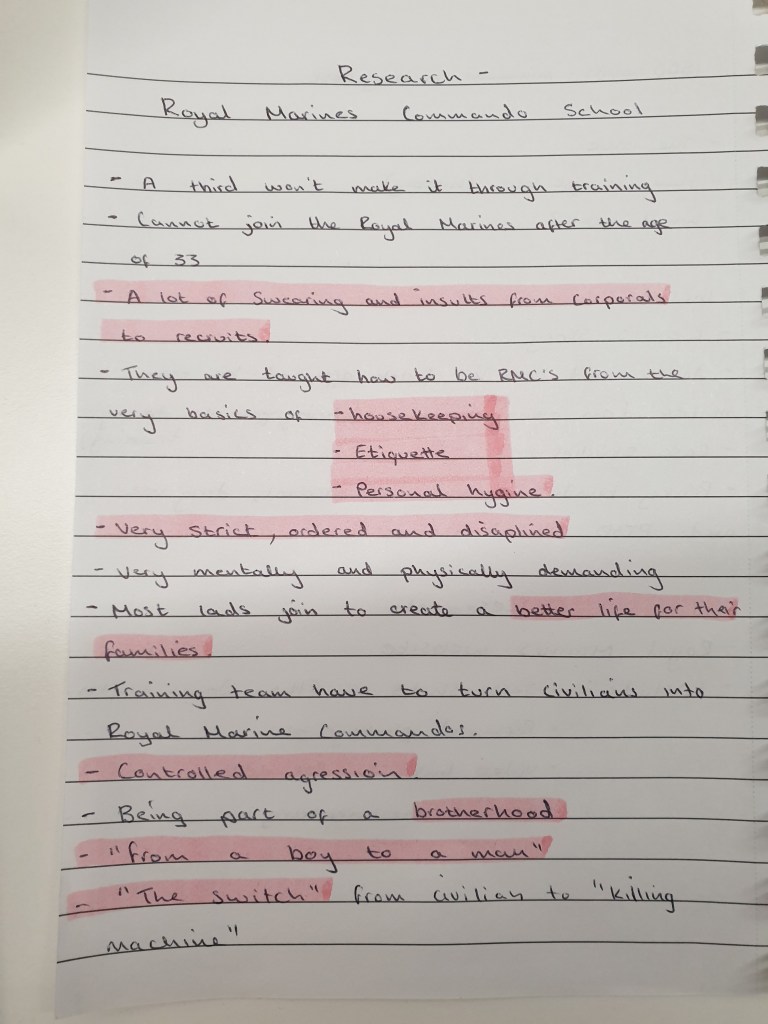
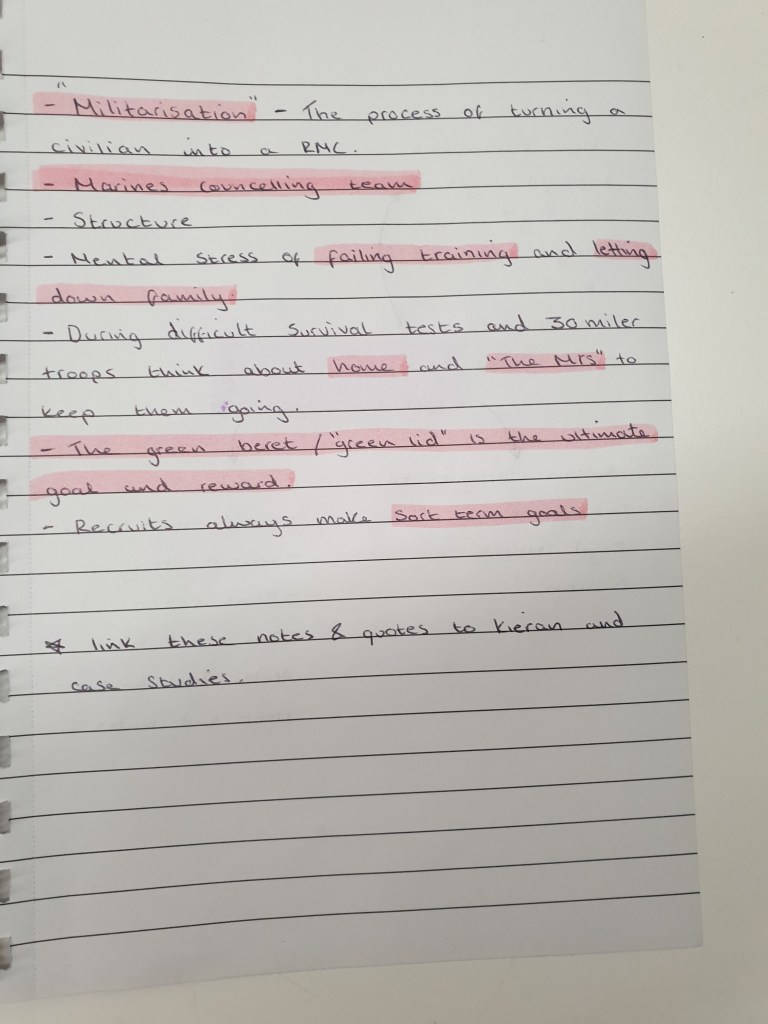
As my boyfriend Kieran is in the Royal Marines, I have already done a lot of research in my own time to understand what he does. As well as doing my own research, I also have a lot of knowledge based on my boyfriends stories and information he has given me. Although I believe that this is the best way to understand the Military lifestyle, I feel that it is also important to do some reattach online from websites and articles.
Firstly, I decided to watch Royal Marines Commando School, which is a documentary following the 180 Troop through their first phases of training. During my boyfriend’s training, I watched this documentary to help me understand what he was doing on a weekly basic as communication between us was very limited. I have decided to re-watch this series to refresh my memory on the intense first stages of training these young men endure. My written notes are shown below. Throughout this project I will keep referencing back to these notes.
The Royal Marines Commando School Documentary follows a new set of recruits on their journey towards pass out. This documentary is made from very raw footage, showing the ups and downs of recruits during their 32 week training. When Kieran had first rejoined, I followed this documentary in my free time to understand the training process he was going through, and to gain an inside of what life on camp is like for a recruit. For this this project, I have decided to rewatch this documentary series to try and ind possible case studies to support Kieran’s behaviours and personality.
Militarisation
Watching the Royal Marines Commando School documentary gave me the insight of the process of militarisation, turning a civilian into a Royal Marines Commando. Every two weeks, a new group of 60 recruits arrive at Lympstone Commando to embark on the worlds toughest Military training. A third won’t make it, but the ones who do will become Royal Marine Commandos.
The Militarisation process begins from day one, as new recruits are taught the very basics of housekeeping, Etiquette and personal hygiene. All aspects of privacy is taken away when the recruits are told they must sleep naked and shower together in shared facilities. This already begins to take way embarrassment and begin a bond between the recruits and begins to form the Royal Marines Brotherhood.
Swearing, insults, shouting and threats are commonly received by recruits from the Training Team. It is seen s character building and used as a tool to get the job done. Communication between the training team and recruits are very straight forward and basic. Group and personal punishments are a common form of discipline.
The most well known aspect of Militarisation is “The Switch”, controlled anger and aggression, as well as the frequent change of mindset from Civilian to Royal Marine Commando and vice versa. Kieran is easily able to switch from Civilian to RMC but struggles the other way around when he is on leave. He has adapted to the Military lifestyle like a fish to water, however struggles to change his mindset when he is in Civvy street. When back in civilian life, Kieran displays a low tolerance for things not being done quickly, efficiently and/or properly, which causes him to speak his mind and appear aggressive and rude to others. This can sometimes be quite upsetting to witness, as fights and altercations usually break out, and a big misjudgement of Kieran’s character to others. I of course know that this is how Kieran has been taught to deal with things so I am able to take this with a pinch of salt. Others however, are very quick to take offence or get angry to Kierans blunt approach. These forms of communication, and overall lifestyle work very well in the Military, so I believe Kieran is reluctant to change his ways in civilian life, as he knows these processes get the job done quickly and effectively.
References
General information and statistics:
- Royal Marines Charity, Royal Marines Mental Health – Working Towards Good Mental Health <https://theroyalmarinescharity.org.uk/RMmentalhealth/>
- Royal Marines Charity, Support That Leaves No One Behind <https://theroyalmarinescharity.org.uk/news/support-that-leaves-no-one-behind/>
- Ministry of Defence, UK Armed Forces Mental Health:Annual Summary & Trends Over Time, 2007/08 – 2018/19 <https://assets.publishing.service.gov.uk/government/uploads/system/uploads/attachment_data/file/809561/20190620_Annual_Report_18-19_O.pdf>
- Royal Navy, (03 April 2019) New Royal Marines Project To Support Royal Marines <https://www.royalnavy.mod.uk/news-and-latest-activity/news/2019/april/03/190403-mental-health-regain>
- Royal Navy, (2019) Regain Marines: When Strength Alone Just Isn’t Enough <https://www.royalnavy.mod.uk/news-and-latest-activity/features/project-regain>
- SAFFA The Armed Forces Charity, (2020), Joining CIVVY Street, <https://www.ssafa.org.uk/get-help/joining-civvy-street>
- Mental Health Foundation, (2020) Armed Forces Mental Health, <https://www.mentalhealth.org.uk/a-to-z/a/armed-forces-and-mental-health>
- Hunt J, Wessely S, Jones N, Rona R.J, Greenburg N, (2014) Mental Health Of The UK Armed Forced: where facts meet fiction, <https://www.ncbi.nlm.nih.gov/pmc/articles/PMC4138705/
- Benjamin R.B, (11-11-2014) What WWI taught us about treating PTSD <https://www.independent.co.uk/voices/world-war-centenary-armistice-day-post-traumatic-stress-soldiers-ptsd-a8628481.html>
Ethan Jones Death
- Timms K, Britten E., Kings J, (31-01-2020) Touching tributes to Royal Marine Ethan Jones who drowned in training <https://www.bristolpost.co.uk/news/local-news/ethan-jones-royal-marines-inquest-3796927>
- BBC News, (30-01-2020) Royal Marine who died after training incident named <https://www.bbc.co.uk/news/uk-england-cornwall-51315550>
- Telegraph Reporters (31-01-2020) Marine recruit died during beach training after spending five minute underwater <https://www.telegraph.co.uk/news/2020/01/31/marine-recruit-died-beach-training-spending-five-minutes-underwater/>
- Forces Net (31-01-2020) Royal Marines Recuit Who Dies After Training Incident Is Named <https://www.forces.net/news/royal-marines-recruit-who-died-after-training-incident-named>
Royal Marines Commando School – Channel 4 (08-06-2014)
- Episode One <https://www.youtube.com/watch?v=vYVbxJR2ffs&list=PLgAfZdKiJiYGludVHxocQv8HqHYCi61le>
- Episode Two <https://www.youtube.com/watch?v=8ZZmOgojpuU&list=PLgAfZdKiJiYGludVHxocQv8HqHYCi61le&index=2>
- Episode Three <https://www.youtube.com/watch?v=VakCrvp0a6U&list=PLgAfZdKiJiYGludVHxocQv8HqHYCi61le&index=3>
- Episode Four <https://www.youtube.com/watch?v=l209YKHfzog&list=PLgAfZdKiJiYGludVHxocQv8HqHYCi61le&index=4>
- Episode Five <https://www.youtube.com/watch?v=7_XgzSJVsYw&list=PLgAfZdKiJiYGludVHxocQv8HqHYCi61le&index=5>
- Episode Six <https://www.youtube.com/watch?v=KxJSFDXa8aE&list=PLgAfZdKiJiYGludVHxocQv8HqHYCi61le&index=6>
- Episode Seven <https://www.youtube.com/watch?v=t1hqjgoWU0A&list=PLgAfZdKiJiYGludVHxocQv8HqHYCi61le&index=7>
- Episode Eight <https://www.youtube.com/watch?v=D5P_A35bzyY&list=PLgAfZdKiJiYGludVHxocQv8HqHYCi61le&index=8>
Royal Marines Adverts
- Royal Marines Recruitment, (04-09-2018) The Mist <https://www.youtube.com/watch?v=gF1F0urb8-w>
- Royal Marines Recruitment, (04-09-2018) Spider <https://www.youtube.com/watch?v=KpvBH38WsNA>
- Royal Marines Recruitment, (24-08-2019) Pirates <https://www.youtube.com/watch?v=h5yQWK8h42U>
 Nadya Cheetham